Reclaiming Connections
Reclaiming Connections is a 10-week program for caregivers of Indigenous youth (ages 8-18). The group meets together each week for 1.5 hours with two trained facilitators.
Before coming to Reclaiming Connections, caregivers meet individually with group facilitators to build relationships and trust, and to inspire hope and motivation. Rooted in the concepts of relationships, adolescence and parenting, each session begins with a guiding principle that relates to and supports caregiving. The program does not tell caregivers how they should parent. Through supportive open discussion and the use of role-plays and reflection exercises, caregivers generate ideas about how best to support their teen and to also balance the need for understanding, safety and guidance. In this way, Reclaiming Connections promotes the belief that relationships, connections and communication are the foundations of caregiving.
Our Journey to Reclaiming Connections
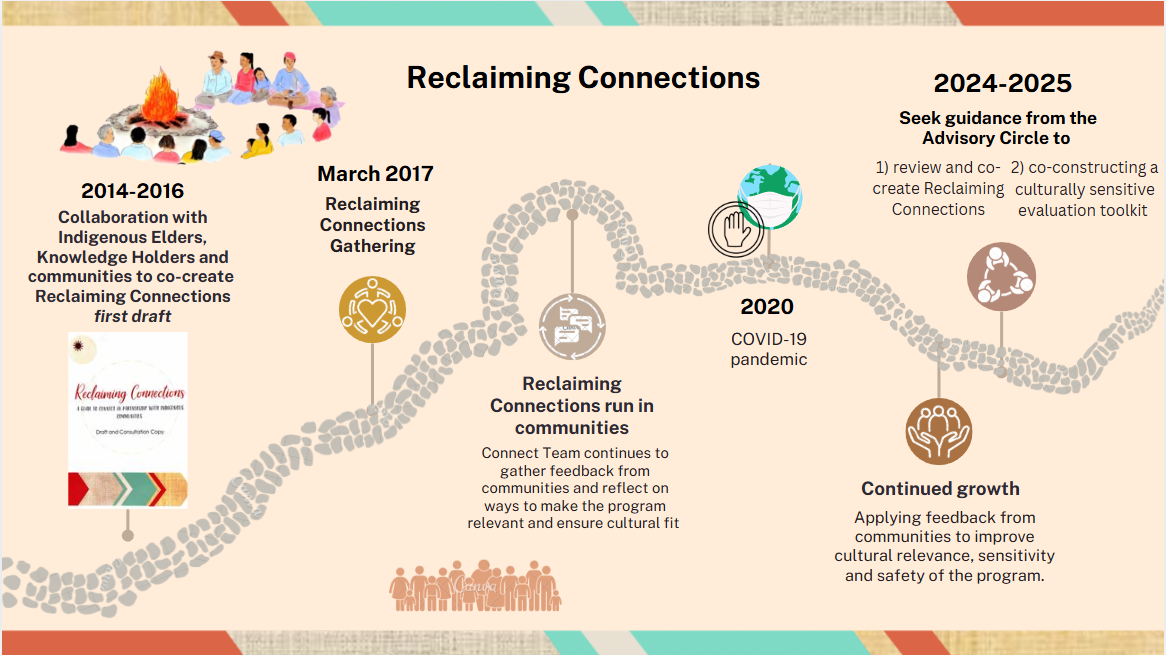
Our journey to develop Reclaiming Connections began in the fall of 2014 through collaborations with a number of Indigenous communities. From the beginning, we sought to listen to and integrate the voices of group facilitators and caregivers, while recognizing and respecting the unique strengths, wisdom, cultural practices, and traditions of caregiving within each community.
Communities generously shared their experiences of the diverse and ongoing impacts of government policies, their understanding of the challenges facing their youth, and their ideas about how best to support the health and well-being of their families and communities. Through these conversations—and through the wisdom, language, and connections to cultural heritage, community, and land that communities shared—the foundations for the co-creation of Reclaiming Connections began to take shape.
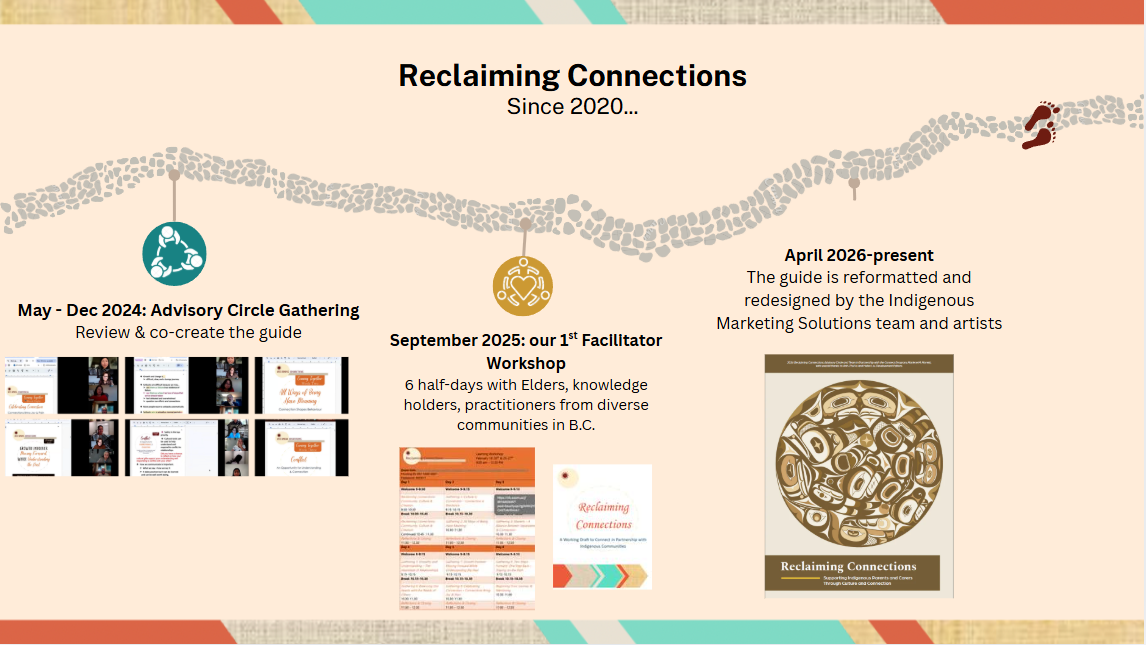
In 2024, we brought together an Advisory Circle of Elders, Knowledge Holders, Indigenous community members, and Indigenous and non-Indigenous practitioners who serve Indigenous families to review and further guide the program. Their wisdom, commitment, and dedication have been instrumental in bringing this guide to completion and making it possible to host our first Reclaiming Connections Facilitator Workshop.
Through continued collaboration and partnership, we continue to gather information and reflect on how to make Reclaiming Connections relevant and ensure cultural sensitivity and safety. Information gathered belongs to each community and with permission, new knowledge will be shared to support the continued co-creation of the program.

Join a Reclaiming Connections Group
If you are interested in finding out about a Reclaiming Connections Group running in your area, click here or email connectattachmentprograms@gmail.com.
For more information about Reclaiming Connections groups for parents or training workshops for Facilitators, Clinicians, and Researchers within BC, please contact:
Siobhan Avery
Email: Siobhan.Avery@gov.bc.ca
For out of province inquiries, please contact:
Adolescent Health Lab
Email: youth_project@sfu.ca
During the Reclaiming Connections Gathering in March 2017 the following illustrations were created by Colleen Stevenson who is a graphic recorder.
Indigenous and non-Indigenous community stakeholders from across British Columbia, Indigenous Elders and Chief, the Maples Adolescent Treatment Centre, Dr. Marlene Moretti, Connect team staff, and the Reclaiming Connections working group gathered together as contributors sharing ideas, experiences, concerns and knowledge with a focus of delivering Reclaiming Connections to Indigenous communities.
Participants examined the program’s core elements, cultural meaning, sensitivity, community fit and safety of the program, integrated through each community representative’s unique Indigenous ways of knowing and being. Community collaborators were encouraged to make suggestions, discussing any concerns they had, keeping in mind the next steps of the program. The goal was to co-create an inclusive community guide together, one that provides suggestions, invites expression within an open exchange of ideas and can be adapted to fit the cultural needs of each Indigenous community. The hope was to co-create a culturally sensitive, resilience and strength based program, one that is relationally focused, supporting Indigenous communities, families and youth.
We were very fortunate to have Graphic Storyteller, Colleen Stevenson join us and express our ideas and reflections in 3 beautiful murals, portraying our daily collaborations together.


“Graphic recording is the real time capturing of dialogue in visual form. Colleen works quickly and quietly to capture the key points and themes, creating an artful composition that engages both the mind and the emotion of participants.
Layers of information become clearly visible with attention to metaphor and culturally-specific imagery. After the event, the images are photographed and distributed to clients electronically for use as follow-up notes that rekindle the passion of the event.
The large format lends itself well to long-term planning, to representing complex issues holistically and to drawing out the contribution of each and every participant. Participants appreciate having information organized visually. They leave seeing that their thoughts are valued, their questions are honoured and their contributions are made visible to the room.”
Sasamans Society Website
https://www.sasamans.ca/graphic-recording/